TheJavaSea.me Leaks AIO-TLP370: What Is Known?

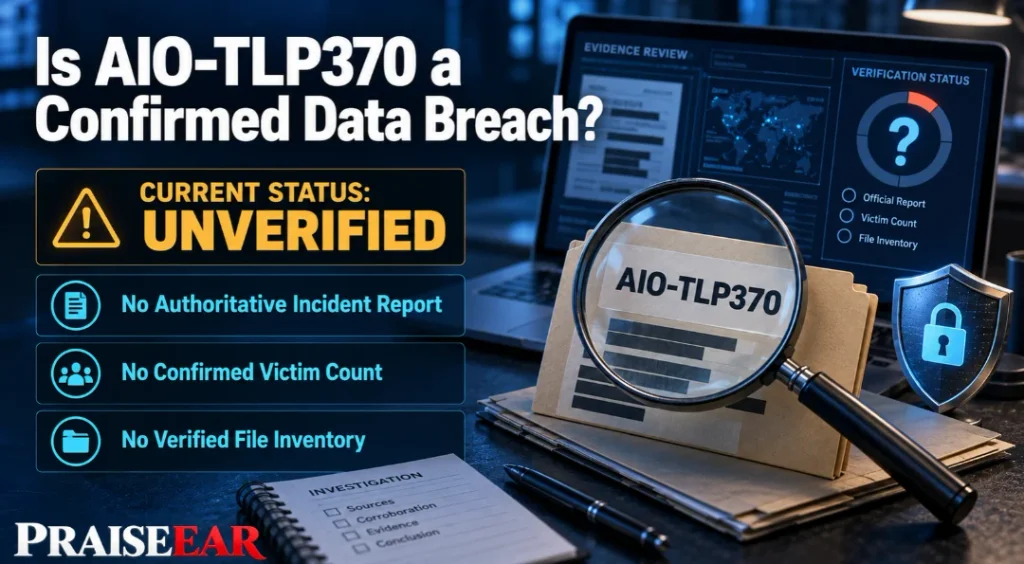
TheJavaSea.me Leaks AIO-TLP370 is a search phrase associated with an allegedly leaked archive or bundled collection of digital material. Although numerous websites discuss the label, no authoritative public report clearly verifies its contents, original source, affected organizations or number of victims.
AIO-TLP370 should therefore be treated as an unverified leak-related identifier, not the confirmed name of a newly documented data breach. Users should not visit leak pages or download associated files to investigate whether their information is included.
Quick Overview
| Question | Current finding |
|---|---|
| What is AIO-TLP370? | An alleged archive, package or thread identifier |
| Is it a confirmed breach? | Not independently confirmed |
| What does AIO mean? | Possibly “All-In-One,” but unverified |
| Is TLP370 an official security classification? | No |
| Are its contents known? | No authenticated inventory was identified |
| Is there a confirmed victim count? | No reliable total is available |
| Should the archive be downloaded? | No |
| Safest response | Secure accounts and use trusted breach-monitoring services |
The existence of online discussion proves only that the label is circulating. It does not confirm that every claim attached to it is accurate.
What Does AIO-TLP370 Mean?
The phrase contains three elements:
TheJavaSea.me
TheJavaSea.me is mentioned in online discussions involving file sharing, leaked content and digital archives.
AIO
“AIO” commonly means “All-In-One.” In file-sharing contexts, it may describe a bundle containing multiple files, tools or datasets.
TLP370
The “370” portion may be a sequence, batch, version or post number. Its exact purpose is unknown.
- TLP
- TLP
- TLP
- TLP
According to the official FIRST Traffic Light Protocol standard, only those defined labels are valid. “TLP370” is not an official sensitivity level and does not certify the archive’s authenticity or seriousness.
Is AIO-TLP370 a Confirmed Data Breach?
Current public evidence does not establish AIO-TLP370 as one confirmed breach involving a named organization.
A verified breach normally has at least one of the following:
- A disclosure from the affected organization
- A government or regulator notification
- Analysis from an established cybersecurity company
- A documented security incident with dates and affected systems
- A validated sample examined by qualified researchers
- Consistent information about exposed data and victim numbers
Some articles claim that the package contains credentials, private communications, source code, API keys or internal records.
Leak archives frequently contain duplicated information, old breaches, public records, fabricated entries or malicious files. An impressive filename or large reported file size does not prove that the material is new or genuine.
Why You Should Not Download the Files
Downloading an alleged leak is not a safe method of checking whether your information was exposed.
Malware Risk
Archives from untrusted sources can contain spyware, ransomware, credential stealers or disguised executable files. Even a document may exploit an unpatched application.
Privacy Harm
Opening, copying or redistributing leaked material can further violate the privacy of affected individuals.
Legal Consequences
Laws differ by jurisdiction, but possessing or sharing stolen credentials, private communications, copyrighted files or intimate material can create serious legal risks.
Fraud and Phishing
Fake leak pages often use trending breach names to attract visitors. They may present deceptive download buttons, request payment, collect login details or redirect users to malicious websites.
Unreliable Evidence
Examining it without proper forensic methods may lead to incorrect conclusions.
How to Check Whether Your Information Was Exposed
You do not need to access AIO-TLP370 directly.
Use a Reputable Breach-Notification Service
Have I Been Pwned allows users to check whether an email address appears in known, verified breaches. It does not provide stolen passwords or downloadable breach files. Newly reported or unverified incidents may not yet appear in established databases.
Do not trust an email simply because it claims to be a breach notification. Navigate to the organization’s website independently rather than following unexpected links.
Review Account Activity
Check important accounts for:
- Unknown sign-ins
- Password-reset requests
- Changed recovery details
- New forwarding rules
- Unrecognized purchases
- Messages you did not send
- Newly connected applications
Sign out unfamiliar sessions immediately.
What to Do If You May Be Affected
Change Reused Passwords
Change the password on the affected account and every other service where the same or a similar password was used.
Use a unique password for each account. A password manager can generate and store strong credentials without requiring you to remember all of them.
Enable Multifactor Authentication
Turn on multifactor authentication, preferably with an authenticator application, security key or passkey where supported.
MFA cannot prevent every attack, but it can stop someone who possesses only a stolen password. CISA recommends MFA as one of the core actions in its Secure Our World guidance.
Protect Your Email Account First
Email often controls password resets for other services. Secure it before less important accounts by changing its password, reviewing recovery methods and checking forwarding rules.
Watch Financial and Identity Records
Contact the relevant bank immediately about unauthorized activity.
The US Federal Trade Commission provides official guidance on what to do after a data breach, including steps that depend on the information involved.
Be Alert for Targeted Phishing
Criminals may use exposed names, addresses or company details to make fraudulent messages appear convincing. Do not provide passwords, verification codes or payment information in response to an unexpected message.
What Organizations Should Do
An organization that suspects its data appears in an alleged archive should not ask ordinary employees to download it.
Its security team should:
- Preserve relevant logs and alerts.
- Contact legal counsel and incident-response specialists.
- Reset exposed credentials and revoke active sessions.
- Rotate API keys, tokens and certificates where necessary.
- Determine whether notification laws apply.
- Communicate verified facts without exaggeration.
- Coordinate with law enforcement or regulators when appropriate.
Frequently Asked Questions
What is TheJavaSea.me Leaks AIO-TLP370?
Its exact contents and origin have not been independently verified.
Does AIO mean “All-In-One”?
That is a common interpretation, but no authenticated source confirms that meaning for this specific package.
Is TLP370 an official cybersecurity label?
No. FIRST’s official Traffic Light Protocol uses TLP, TLP, TLP and TLP.
Is AIO-TLP370 confirmed to contain passwords?
Treat specific content claims as unverified.
Is it safe to download AIO-TLP370?
No trustworthy reason exists for an ordinary user to download it. Unknown archives may contain malware, stolen information or illegal material.
Should I pay someone to remove my information?
Be cautious. Paying an unknown person does not guarantee deletion and may expose you to further fraud. Use official company, regulator or law-enforcement channels.
Final Assessment
Online repetition does not establish its contents, scale or authenticity, and “TLP370” is not an official Traffic Light Protocol classification.
Avoid the alleged archive and any website offering direct access to it. The useful response is to secure your email and other important accounts, replace reused passwords, enable MFA, monitor for suspicious activity and rely on trusted breach-notification services.
Discover more Praiseearcouk
For a separate guide to content saved in apps, read Snapchat Storage.